Research
Language and music
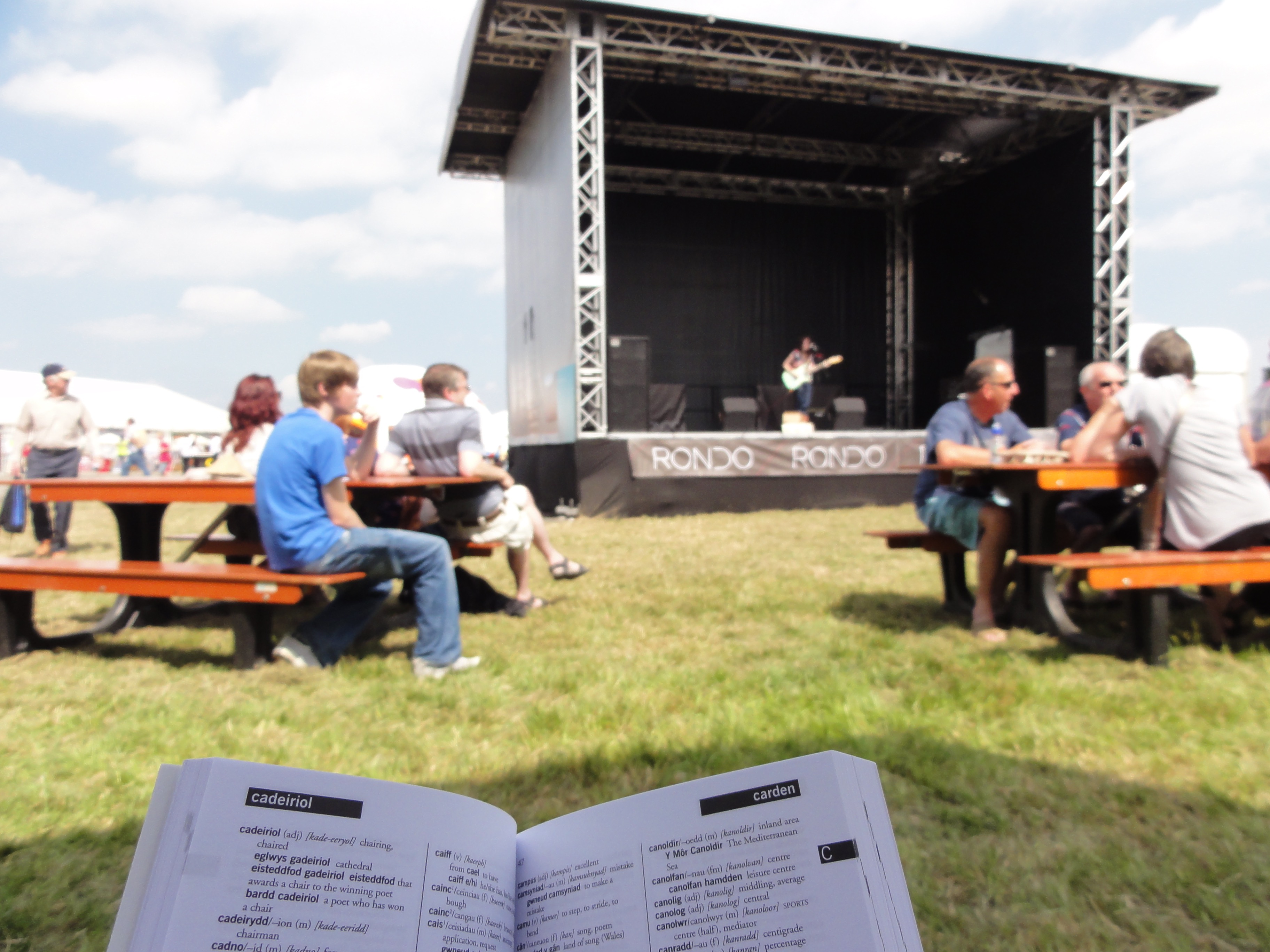
As a lifelong musician, the intersection of language and music has been at the heart of my linguistic interests from the start. I’m interested in the potential of music for language revitalization efforts, and also in the integration of musical and linguistic data in linguistic analysis — what can we learn by treating the combination of music and language as a holistic site of inquiry rather than than simply language data with a melody?
To that end, in my work, I focus on describing new methodologies that combine ethnomusicological and linguistic approaches, and applying them to questions of structural linguistics, sociocultural linguistics, and language revitalization.
A few projects I work or have worked on with regards to music and language include:
Critical Multilingualism Studies 12(1), 2025, p. 25-56. https://doi.org/10.2458/cms.6463
Open access - download the PDF here!
On how cotemporal code-switching and musical style-shifting enable three Welsh popular music acts to construct shifting bilingual identities.
In Framing Sustainability in Language and Communication (Routledge, 2025), p. 221-239. https://doi.org/10.4324/9781032719214-17
Open access - download the PDF here!
With Jessica Love-Nichols, a musicolinguistic analysis of eco grime and solarpunk music which shows how these genres reimagine "the club" as a space of sonic environmental activism, and convey environmental concerns and a 'sensorial sustainability' through both language and music.
Canadian Journal of Applied Linguistics / Revue canadienne de linguistique appliquée 27(2), 2024, p. 52-84. https://doi.org/10.37213/cjal.2024.34535
Open access - download the PDF here!
On how linguists can help contribue to musical language revitalization through the creation of UTAUloids - singing synthesizers intended for low-resource, collaborative vocal music production - illustrated through a case study in ᏣᎳᎩ (Cherokee).
Language Documentation & Conservation 16, 2022, p. 168-208. https://hdl.handle.net/10125/74672
Open access - download the PDF here!
With Griselda Reyes Basurto, on integrating musical data into language documentation in ELAN, Praat, etc., and on the relationship between musical melody and linguistic tone in Tlahuapa Tù'un Sàví (Mixtec, Guerrero).
(manuscript in progress; earlier presentation version: slides)
Musicolinguistic study of how vaporwave is constructed as a genre through both music and (spoken and visual) language, and how specific musical production techniques license imagined musicolinguistic landscapes in the minds of listeners, allowing them to experience the genre's central themes.
Language in Japanese popular media

Much of my research also involves exploring the role of language in Japanese popular media (such as manga, anime, and videogames), both in the original Japanese and in translation. Like my work on music and language, this research stems from an interest in interdisciplinarity and multimodality, and uses methods from linguistics alongside relevant methodological lenses from other disciplines, such as comic, media, videogame, and island studies.
A few of the projects I've worked on in this area include:
Mechademia 17(2), 2025, p. 168-189. https://muse.jhu.edu/article/960866
Open access - download the PDF here!
With James Crayton, on the narrative role of the multilingual (English, Māori, and Japanese), multimodal linguistic landscape in the photography-based videogame Umurangi Generation, and introducing the concept of ‘ludolinguistic landscapes’ – virtual linguistic landscapes as shaped by and experienced through the affordances of interactive gameplay.
Shima 19(1), 2025, p. 317-335. https://doi.org/10.21463/shima.249
Open access - download the PDF here!
With Emi Boonin, on the imaginary possibilities of waterscapes represented in the 2002 Japanese manga Aria, and how its setting of 'Neo-Venezia' reimagines the Venetian aquapelago through solarpunk, Slow Life sustainability, and both Venetian and Japanese cultural practices. We draw on the manga (in Japanese and English translation), as well as reader commentaries in Japanese, Italian, and English, to explore how Neo-Venezia is constructed and interpreted as model for a utopian imagined future in the face of climate change.
Journal of Anime and Manga Studies 2, 2021, p. 121-154. https://doi.org/10.21900/j.jams.v2.825
Open access - download the PDF here!
With Daphne Iskos, a study using methods from sociocultural linguistics and comic studies to show how differences in the use of loanwords, honorifics, onomatopoeia, and iconicity in each of two translations of Sailor Moon serve to either erase (in the case of the earlier release) or actively construct (in the case of the later) the sociocultural construct of 'Japaneseness' within the text.
(manuscript in progress; earlier presentation version: poster)
Sociophonetic study which shows how bundles of phonetic features are used in anime to create equivalence between a physical characteristic – in this case, the main character's fatness – and a sociocultural category – here, her status as a fujoshi (a female fan of media depicting homoerotic male relationships), contrasting both of these against performances of traditionally desirable anime femininity.
Patagonian Welsh
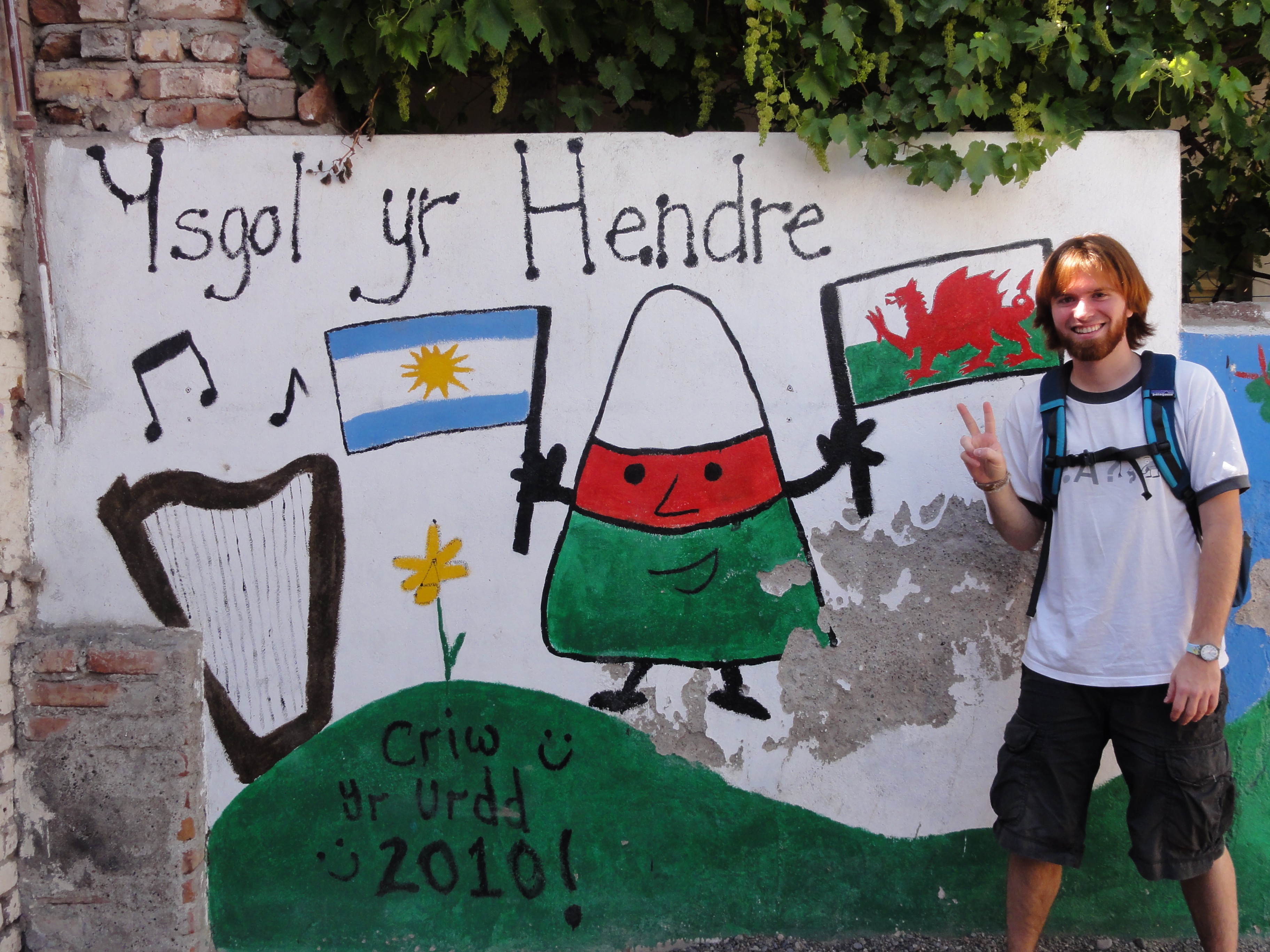
As part of my Watson Fellowship in 2011-2012, I travelled to Chubut, Argentina to learn about music and language revitalization in Welsh-speaking Patagonia (Y Wladfa), and became fascinated by the language and culture of this unique region. Since then, I have aimed to help document the distinctive features of this understudied variety of Welsh, as well as what its structure and usage can tell us about language contact. Much of my work utilizes the fantastic Bangor Siarad and Bangor Patagonia corpora, and is thus representative of naturalistic, conversational speech — including code-switching into Spanish and English.
Some of the results of this work can be seen here:
Journal of the International Phonetic Assocation 50(2), 2020, p. 153-167. https://doi.org/10.1017/S002510031800021X
Pre-print PDF available here!
Corpus study using linear mixed-effects modeling, showing that Patagonian speakers produce the voiceless stop series /p t k/ with lower average VOT values than speakers from Wales, as a result of contact with Spanish.
Journal of Celtic Linguistics 21(1), 2020, p. 143-172. https://doi.org/10.16922/jcl.21.5
Pre-print PDF available here!
Corpus study using conditional inference trees and random forests, showing that for both Patagonian and Welsh speakers, the geographical and cultural ‘Welshness’ of placenames affect their mutation behaviour following yn ‘in’, and that soft mutation has become an important component of this prescriptively nasally-mutating environment.
More
Besides these three main areas, my research interests also include linguistic landscapes, language contact, code-switching, and revitalization more broadly, as well as Cherokee, Bergamasco, and Ainu.

Presenting at the March for Science, Santa Barbara, CA, 4.22.2017